READ THE CLOTHES, THEN CHOOSE THE LOOK
Victorian Fashion by Decade: A Guide to 1837–1901
Victorian fashion changed substantially between 1837 and 1901. A long-waisted 1840s dress, a wide 1860s hoop skirt and an 1880s bustle create different outlines, even before you consider fabric or jewellery. Start with the decade, then the occasion. This guide follows fashionable adult dress in Britain and its wider Western fashion context; it does not describe everyone living under Victorian rule or every kind of working clothing.
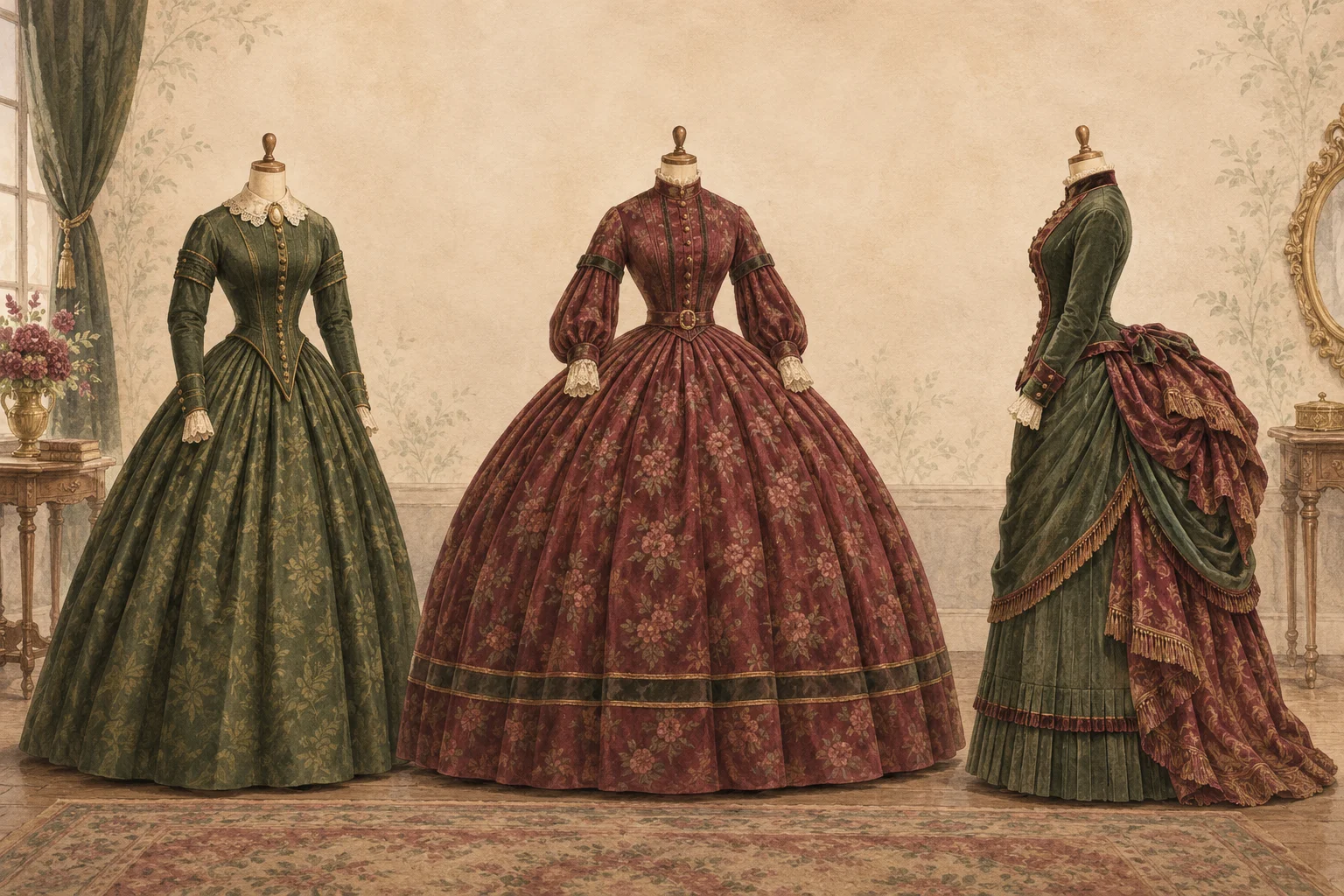
Victorian fashion timeline: the outline at a glance
Read a dress from the outside inward: where is its widest point, how does the waist sit, and where does the skirt carry its volume? Those questions help distinguish silhouettes that a generic “Victorian” label puts together. The dates below are a guide to changes, not switches that everyone followed on the first day of a new decade. Each row links to FIT’s detailed fashion-history research and its dated examples.
| Period | What to look for | Source |
|---|---|---|
| 1837–1839 | Sleeve volume subsides; the upper body becomes less expansive. | FIT: 1830–1839 |
| 1840s | Long pointed bodices, sloping shoulders and full skirts. | FIT: 1840–1849 |
| 1850s | Rounded skirts grow wider; the steel cage crinoline arrives in 1856. | FIT: 1850–1859 |
| 1860s | Broad hoops give way to skirts with more fullness behind. | FIT: 1860–1869 |
| 1870s | Back drapery and the first bustle; a slimmer line later in the decade. | FIT: 1870–1879 |
| 1880s | An initially slender line, then the prominent second bustle. | FIT: 1880–1889 |
| 1890s | Bell-shaped skirts, large upper sleeves and tailored separates. | FIT: 1890–1899 |
| 1900–1901 | The turn-of-century S-shaped silhouette; styles cross the reign boundary. | FIT: 1900–1909 |
Victoria’s accession in 1837 falls inside an existing decade; the early-1830s fashion for enormous sleeves should not stand for her whole reign. Likewise, the turn-of-century styles in the final row continued into the Edwardian years. A political period and a clothing style do not have identical boundaries.
How women’s dress moved from full skirts to bustles
The 1840s: an elongated bodice
A useful starting point is the relationship between the shoulder and waist. In the 1840s, a fitted, often pointed bodice and low-set, narrow sleeves emphasized a long torso and sloping shoulders. Full skirts balanced the close upper body. FIT’s 1840s overview places these features alongside surviving dresses and portraits. When comparing images, follow the actual waist seam rather than assuming that every dark fitted dress belongs to this decade.
The 1850s and 1860s: volume around the body
The expanding skirt changed the wearer’s whole footprint. The 1850s overview describes the introduction of the steel cage crinoline in 1856, following skirts supported by layered petticoats. A crinoline supports fullness around the body; it is not another name for a bustle. During the 1860s, the broad rounded skirt gradually became flatter in front and fuller behind. A side view can reveal that change more clearly than a tightly cropped portrait.
The 1870s and 1880s: volume behind the waist
The first bustle of the early 1870s gathered drapery toward the back. Later in that decade, the fashionable line became closer to the body. The 1880s overview distinguishes this slim beginning from the more rigid, projecting bustle that returned around 1883–1884. A bustle is the support and resulting shape at the back; a train is the fabric extending along the ground. An elaborate train alone cannot date a gown or prove which support is underneath it.
The 1890s: attention moves to the sleeves
The silhouette changed again as the large bustle disappeared. Bell-shaped skirts and enlarged upper sleeves became important visual cues; the sleeve volume was especially pronounced around the middle of the decade. FIT’s 1890s research also discusses tailored separates and clothing for activities such as cycling. When building a visual reference, compare the shoulder width and skirt together. Copying a sleeve from one year onto a skirt from another may produce an appealing image, but it needs a more cautious historical label.
Men’s Victorian clothing depended on the occasion
Coat, waistcoat, shirt and trousers form a useful starting vocabulary, but the cut and setting matter. The Bow Street Police Museum’s menswear account explains the frock coat’s waist seam and skirts, and the growing acceptance of the lounge suit during the later nineteenth century. It also shows how accessories and the condition of clothing could communicate status. A richly embroidered uniform should therefore not be used as an example of every man’s daily suit.
For a late-century brief, distinguish formal daywear, evening dress and relaxed settings. FIT’s 1890s menswear section separates frock and morning coats, lounge suits, white-tie tailcoats and the emerging dinner jacket. If you are studying a portrait, note the coat fronts, collar, neckwear and accompanying trousers before assigning a name. “Victorian gentleman” is a mood; a dated garment and an occasion make a usable reference.
Victorian fashion was not all black
Mourning portraits can distort our impression of a whole wardrobe. The Ashmolean Museum’s colour research explains how chemistry and textile production helped popularize vivid colours. William Henry Perkin’s discovery of mauveine in 1856 is one part of that story. The museum also distinguishes Queen Victoria’s long mourning wardrobe from the wider taste for colourful dress. A black-and-white photograph is not a colour chart, and one royal wardrobe is not a complete account of an era.
Use colour as a second question after silhouette. For a precise study, look for a collection record that identifies the object’s date and material. Check whether you are looking at a surviving garment, a painted portrait or an idealized fashion plate. They answer different questions. Wealth, occupation, locality and occasion also narrow the claim you can make; a fashionable evening gown is a poor stand-in for clothing worn at work.
Turn a historical reference into a portrait brief
Start with three decisions: a decade, an occasion and the feature you want to see. A full-length or three-quarter view helps show skirt shape; a head-and-shoulders crop puts the emphasis on face, collar and accessories. Describe the setting only after choosing the clothing. A chandelier or a stone hallway cannot make an otherwise mixed outfit historically consistent.
HistoryOutfit currently offers two Victorian-inspired options: an evening gown and a court-uniform-inspired look. The gown’s emerald-and-gold styling provides an ornate evening direction; the navy-and-gold uniform provides a ceremonial one. These are artistic options, not a selectable wardrobe for all eight periods in the timeline. The examples below were made through the actual product generation flow with synthetic adult source portraits.
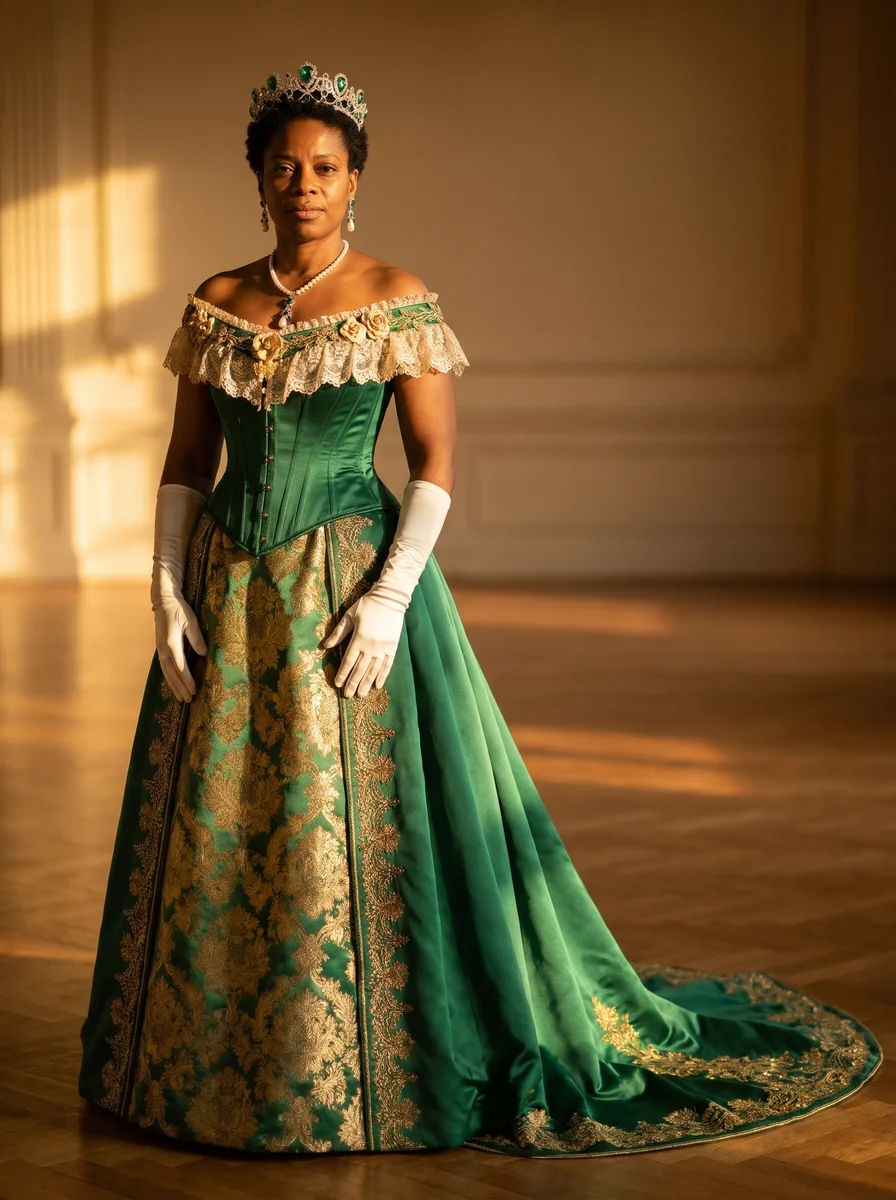
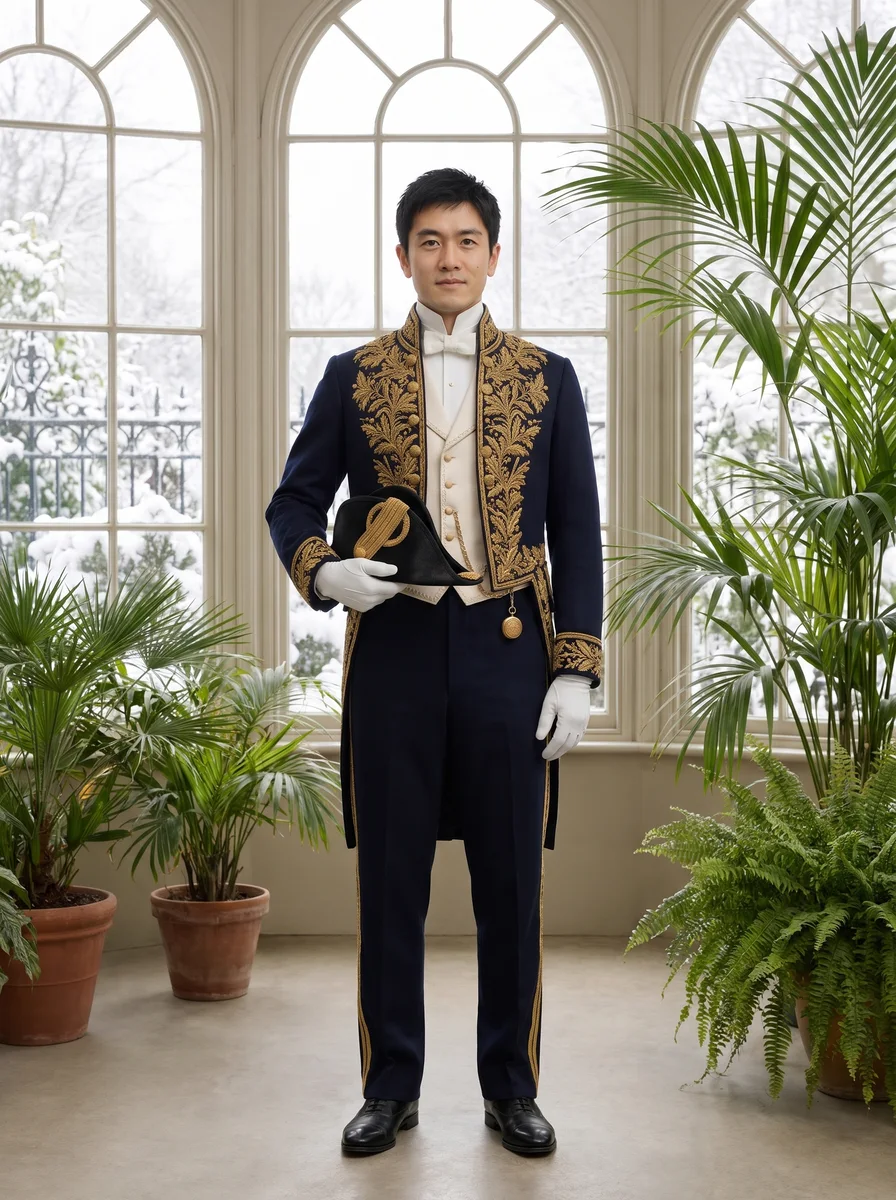
In these two selected tests, the main garment colours, silhouette and accessories remained recognizable, and each output showed one person in a continuous scene. Face features were visually compared with the synthetic source. Folds, lighting and smaller details changed. This is a two-example illustration of the workflow, not a guarantee of likeness or an accuracy score for future portraits.
Check a dated source before choosing a detail
- Name the date and place. Use “mid-1880s British evening inspiration” when that is the scope, rather than claiming a universal Victorian look.
- Match the whole outline. Compare bodice, sleeves and skirt together; a single accessory is not enough to date an ensemble.
- Separate the occasion. Keep court ceremony, evening entertainment, daywear and working clothing distinct.
- Keep evidence beside the image. Save the museum or university record with your brief. Label modern illustration and AI interpretation separately.
For a digital portrait, choose one of the available styles and use the scene field for pose, lighting and surroundings. Review your face, hands, garment outline and accessories before sharing. Generation requires an authorized adult photo, sign-in and paid credits. The photo-to-portrait guide explains the workflow; pricing and the photo-processing policy explain the current purchase and upload conditions.
Editorial note: this is a source-based visual introduction, not an exhaustive dress history. Institutional references were reviewed on 15 November 2026. The cover is an AI-created illustration; the two product examples are documented AI outputs. HistoryOutfit publishes this guide and sells credits for its portrait service.