FASHION HISTORY · ROMAN CLOTHING
Toga, Tunic and Stola: How Ancient Roman Clothing Worked
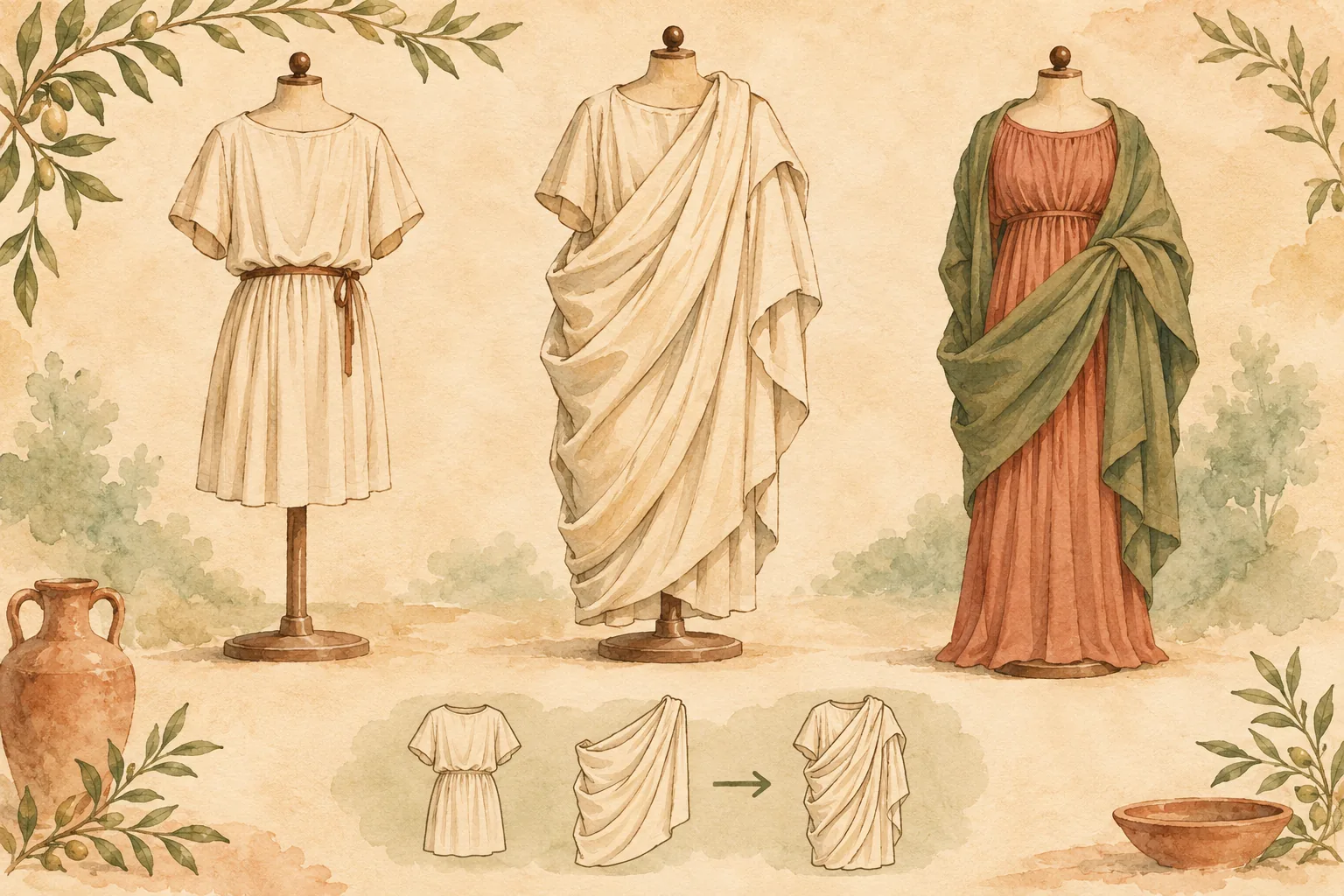
Toga vs tunic vs stola: compare the layers first
A garment’s position on the body is more useful than the amount of fabric in a picture. Look for the layer that covers the torso, then follow any separate cloth crossing the shoulders. The comparison below draws on the Archaeological Institute of America’s guide to clothing in Roman art and the Royal Ontario Museum’s toga guide.
| Garment | Layer or form | Context to check |
|---|---|---|
| Tunic / tunica | Body garment, sometimes belted; lengths and sleeves vary. | Work, household, public or other setting? |
| Toga | Large draped cloth worn over a tunic. | Public role, occasion and variant? |
| Stola | Long garment associated with the married matron. | Social ideal or an identifiable layer? |
| Palla | Rectangular mantle, sometimes covering the head. | What clothing is underneath? |
The practical distinction is that the toga goes over the tunic. A visible belt does not turn one into the other, and a mantle alone does not establish that the garment underneath is a stola. When the layers disappear behind overlapping folds, keep the identification provisional.
The tunic gives a better starting point for daily clothing
The AIA guide, written by Getty Museum educator Shelby Brown, compares formal images with less formal scenes. Its examples include Pompeian tavern imagery with men in coloured, mid-calf tunics and a woman carrying wine in a long tunic. It also discusses an attendant in a short belted garment. These examples interrupt the familiar picture of a population dressed entirely in sweeping white togas. They are still selected representations, with their own subjects and conventions. Read the illustrated comparisons.
For a character reference, describe the visible garment before assigning a rank: “belted tunic, sleeves visible, lower legs free” records more than “ordinary Roman.” Do not infer a person’s legal status solely from plain cloth or a short hem. A picture needs its setting and the collection’s interpretation alongside it.
The toga communicates a public role
A specific statue shows why context matters. The Met’s first-century CE marble togatus wears a toga over a tunic. The museum describes a woollen cloth with rounded edges and connects Augustus’s promotion of the garment with public conduct in the forum. A scroll container at the figure’s feet identifies a man engaged in public business. This is a carefully presented civic identity, rather than a neutral photograph of someone getting dressed.
That distinction changes how you use the image. It supports a brief about formal public appearance in an Augustan context. It does not establish what every inhabitant of the empire wore at home, how a worker dressed for a task or what clothing was comfortable in every province. Treat the object’s date as part of the reference, rather than dropping it once you have found attractive folds.
A purple border and an embroidered purple toga mean different things
The ROM distinguishes the plain toga virilis, the purple-bordered toga praetexta, the bright toga candida associated with seeking election, and the dark mourning toga pulla. It relates the decorated toga picta to triumphal display and describes a purple-and-gold imperial version. Its list of toga variants is useful for checking the occasion before selecting a colour scheme.
A modern purple-and-gold portrait therefore needs a ceremonial label. “Senator,” “emperor” and “Roman man” do not all describe the same clothing brief. Colour is one clue within a documented ensemble; adding a laurel-style headpiece cannot identify a named wearer or date an otherwise invented outfit.
Stola and palla describe clothing and an ideal of womanhood
The University of Queensland’s Roman Matron display centres on a marble portrait head dated 30 BCE–50 CE. Its head-covering palla would have continued over the body and a stola. The museum explains the combination through Roman ideals of modesty and trustworthiness. It also cautions that the cumbersome stola may have been reserved for ceremonial occasions.
Read that as a claim about a represented social identity. It does not mean every woman in Roman territory wore an identical dress, or that a long dress proves marriage. The surviving head and its mantle are material evidence; the account of the missing body and public meaning involves interpretation. Keep both parts in view when using a fragmentary statue as a reference.
The same museum’s Clothing discussion explains how Roman writers used dress to praise or condemn behaviour. Such writing reveals social expectations and anxieties. A moral complaint about luxury is evidence of an argument, rather than a census of what women actually wore.
What a statue cannot tell you about a whole wardrobe
Evidence varies by place. The Roman dress research hosted by the Römisch-Germanisches Zentralmuseum explains that reused textile scraps in Britain can reveal cloth without preserving a complete garment’s form. Brooches and tombstone images provide other clues, but their placement, date and interpretation need care. Provincial dress could also express local traditions alongside Roman names and commemorative practices.
Before copying an outfit, save a short evidence note: the object’s date and find place; whether you are viewing textile, sculpture or painting; the visible layers; and the details you cannot establish. If the record says marble, do not treat the stone surface as a fibre identification. If only the upper body survives, leave the lower garment uncertain. This makes a reference useful without pretending to have recovered the entire costume.
Choose a Roman-inspired portrait with a precise label
HistoryOutfit’s Roman collection offers Roman Stola and Palla and Roman Toga Picta. The first uses ivory drapery and a purple mantle; the second uses purple-and-gold ceremonial styling over a pale tunic. These are two artistic options, not a wardrobe of all the garments discussed here.
For your image caption, name the selected inspiration and keep the claim proportionate: “AI-created stola-and-palla-inspired portrait” or “Roman ceremonial inspiration.” Check the layering, hands, face and accessories before sharing. Use the museum sources for historical study; the generated folds and fastenings are not evidence for reconstructing an ancient garment. The examples below illustrate the available product directions.
Compare the available portrait interpretations
These examples are existing HistoryOutfit test outputs made with synthetic adult source portraits. They illustrate the available creative styles; they are separate from the historical sources cited above. Clothing details and facial features can change in an AI result.
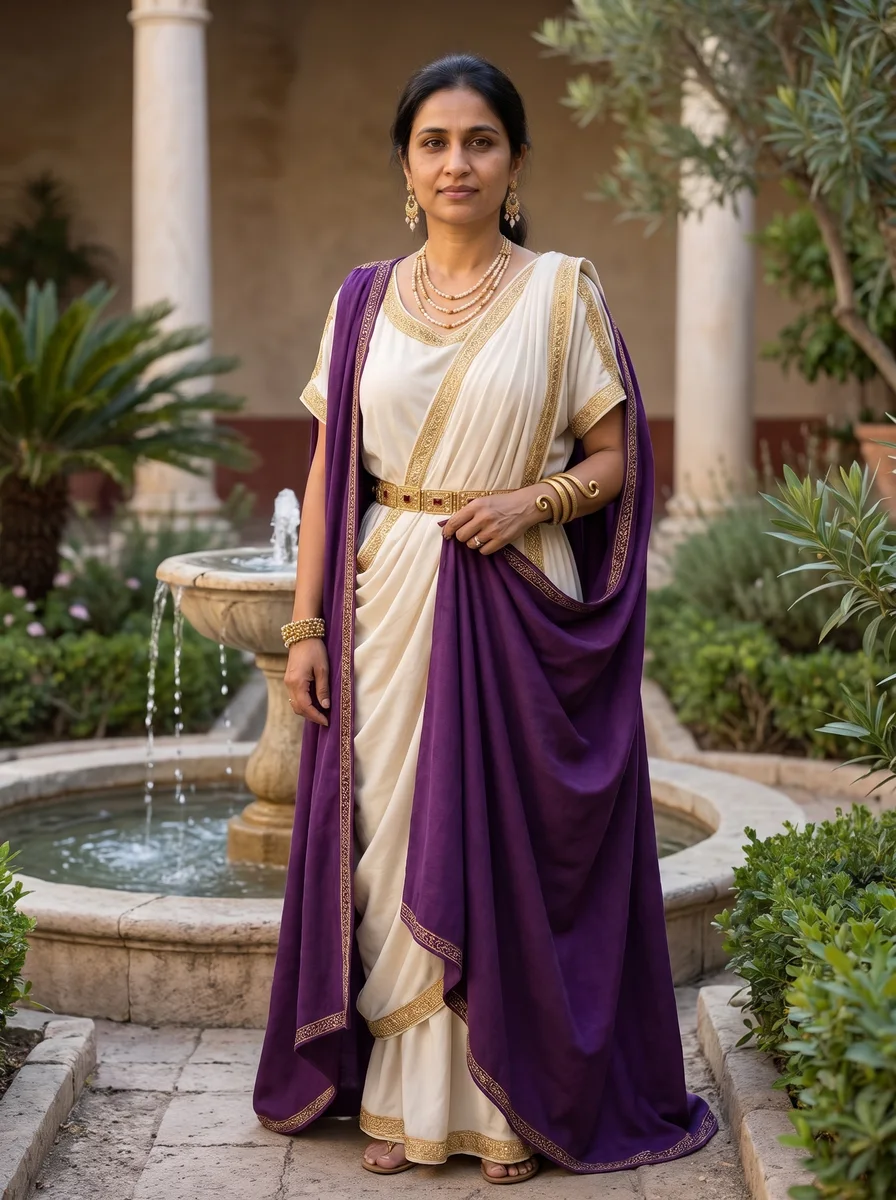
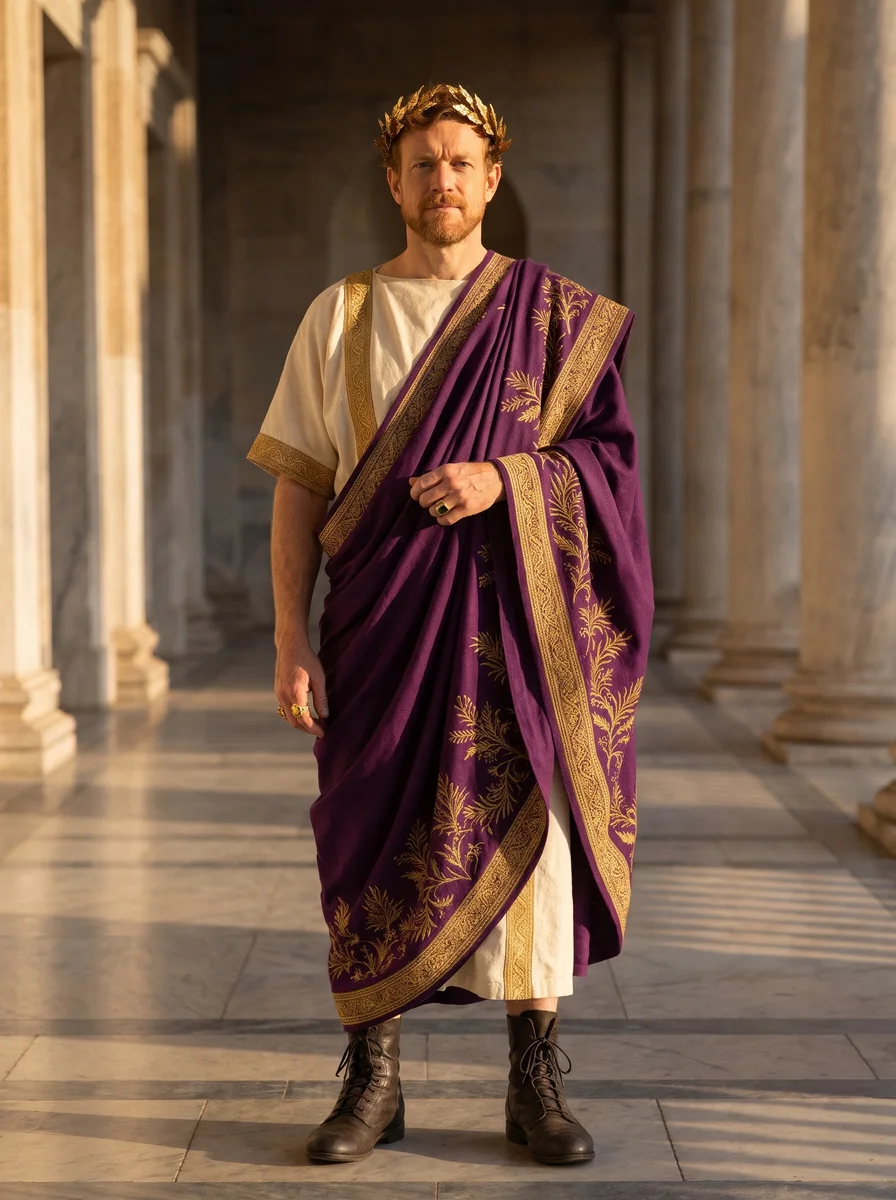
Choose an available outfit first, then use the scene field for pose, background and light. Review the face, hands and garment outline before sharing. The photo-to-portrait guide explains the workflow; see pricing and the photo-processing policy before generating.
Editorial note: this source-based introduction was researched with AI assistance and edited for the stated historical scope. Sources were reviewed on 15 November 2026. The cover is an AI-created editorial illustration, not a verified reconstruction; the product examples are documented AI outputs. HistoryOutfit publishes this guide and sells credits for its portrait service.