FASHION HISTORY · RENAISSANCE DRESS
Renaissance Clothing: Reading Gowns, Doublets and Portraits
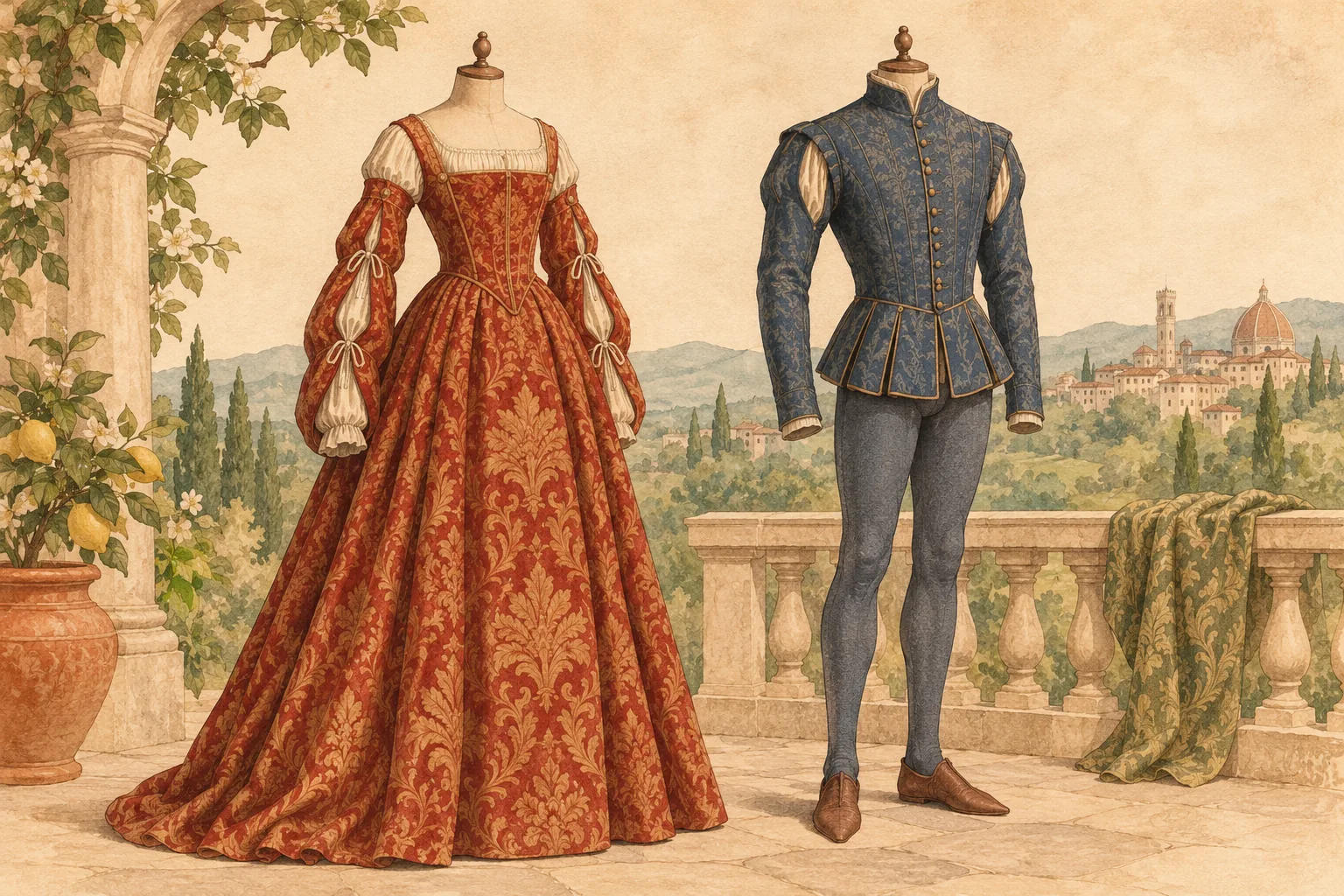
First separate the garment from its decoration
A red-and-gold surface tells you less about a dress than its waist, neckline and sleeves. Start with the shape, then look at which layers are visible. The distinctions below are a reading aid assembled from dated examples; they are not names for interchangeable outfits.
| Term | What it describes | A useful reference |
|---|---|---|
| Gamurra | A fitted Italian dress; in the Florentine examples, a bodice joins a gathered skirt over a chemise. | FIT: Florence in the 1480s |
| Brocade | A patterned woven textile, rather than a gown cut or a precise date. | Uffizi: Eleonora, about 1545 |
| Doublet | A close-fitting jacket; examine it separately from the shirt, legwear and any outer layer. | Royal Collection: Darnley’s portrait |
Record the place and date beside each term. A Florentine dress from the 1480s and a court outfit from the 1560s may both appear under a Renaissance search, but combining their details produces a new interpretation. For historical study, keep each ensemble together.
Read an Italian gown from the inside outward
FIT’s 1480s research describes a linen chemise beneath the gamurra. In its Florentine examples, the dress has a fitted bodice and gathered skirt; the chemise can show at the neckline, front fastening and sleeve gaps. That pale fabric belongs to another layer. It need not be a separate decorative strip sewn onto the outside.
The same research distinguishes the gamurra from outer garments such as the giornea, which can reveal the dress beneath through its open sides. When a portrait shows two fabrics, trace their edges before calling them panels of one gown. Ask where a sleeve attaches and whether the outer fabric continues across the torso. This prevents a common visual mistake: treating every contrasting surface as one continuous garment.
Keep the terminology local. These examples explain particular Italian arrangements; they do not establish the name of every gown in England, France or the German-speaking lands. If a museum labels an object simply as a dress, preserve that wording until a more specific identification has evidence.
What Eleonora’s brocade tells us about a portrait
Bronzino’s portrait of Eleonora di Toledo with Giovanni, dated about 1545 by the Uffizi, makes expensive dress part of its subject. The museum identifies silk brocade and connects the presentation of Eleonora with her dynastic and political position. The gown is therefore evidence of a carefully presented elite image, not a sample of an ordinary Florentine wardrobe.
This also explains why “brocade gown” is a useful creative label but an incomplete historical description. It directs attention toward a rich patterned surface. It does not identify the underlying cut, establish who could wear it or date an unfamiliar portrait. Compare the textile with the neckline and sleeve structure before drawing a conclusion. Copying the motif alone leaves most of the clothing question unanswered.
A doublet belongs to a larger outfit
The Met’s surviving doublet, about 1580, is catalogued as European, possibly Spanish, and made with silk, metallic thread and brass. Keep the museum’s geographical uncertainty: “possibly Spanish” should not become a definite national attribution in a caption. The object supplies a dated garment reference, but its record does not make it a universal Renaissance uniform.
For an ensemble comparison, the Royal Collection Trust’s discussion of Lord Darnley identifies his fitted doublet, full hose and white linen ruff. Look at the relationship between jacket and legwear, rather than describing everything below the waist as modern trousers. This is a Scottish royal portrait context; it should not be relabelled as everyday clothing for all British men, or used to date a much earlier Italian image.
A cropped image may hide those relationships. For a study board, save the complete portrait as well as the attractive sleeve detail. A tight headshot cannot tell you the shape of the legwear, and an outer garment may conceal the doublet’s waist.
Tools in a portrait do not make it everyday workwear
Moroni’s The Tailor, 1565–70, offers a useful check on social assumptions. The National Gallery discusses the sitter as a successful professional, possibly a guild officer or cloth merchant. His shears identify a connection with the cloth trade, while his sword belt contributes to the reading of his standing. The precise identity remains uncertain.
Use that uncertainty constructively. Write “a prosperous cloth-trade sitter” when that is what the evidence supports. Avoid turning one well-dressed subject into a rule about what every tailor wore while working. A portrait can show occupation and ambition at the same time. Neither a tool nor a jewel explains the whole outfit alone.
Build a reference that keeps its context
For each image, save four things: the museum record, its date and place, the sitter’s known role, and the visible garment layers. Separate observations from guesses. “White cloth visible at the sleeve opening” is an observation; a claim about its fibre or fastening needs supporting information. Check an event’s own requirements separately if your goal is a physical faire costume.
For a digital interpretation, HistoryOutfit currently offers a Renaissance Brocade Gown and Renaissance Doublet. They provide two ornate artistic directions, rather than every dated ensemble discussed here. Use the research to describe your inspiration accurately; choose the actual available outfit in the collection. A generated portrait can explore colour and silhouette, but cannot verify a historical attribution or supply a sewing pattern. The photo-to-portrait guide covers the practical workflow.
Compare the available portrait interpretations
These examples are existing HistoryOutfit test outputs made with synthetic adult source portraits. They illustrate the available creative styles; they are separate from the historical sources cited above. Clothing details and facial features can change in an AI result.
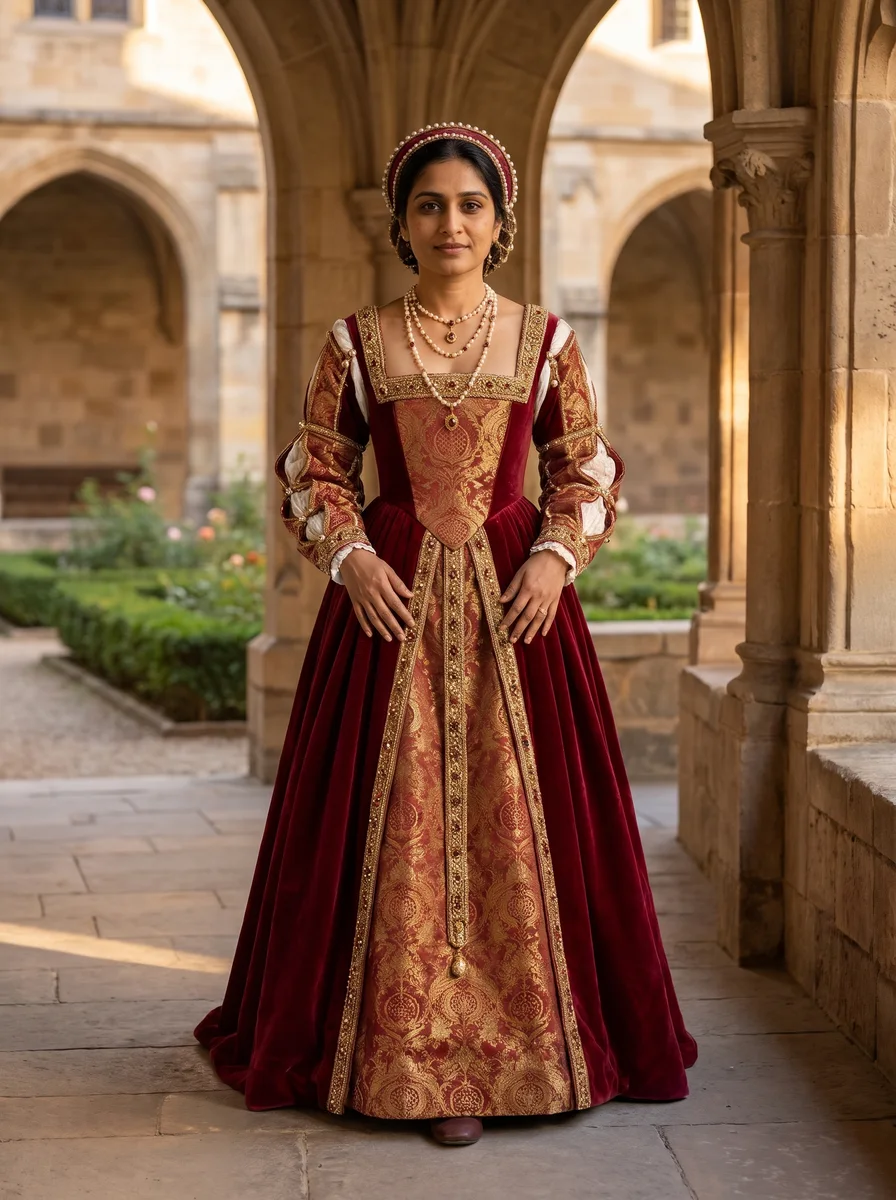
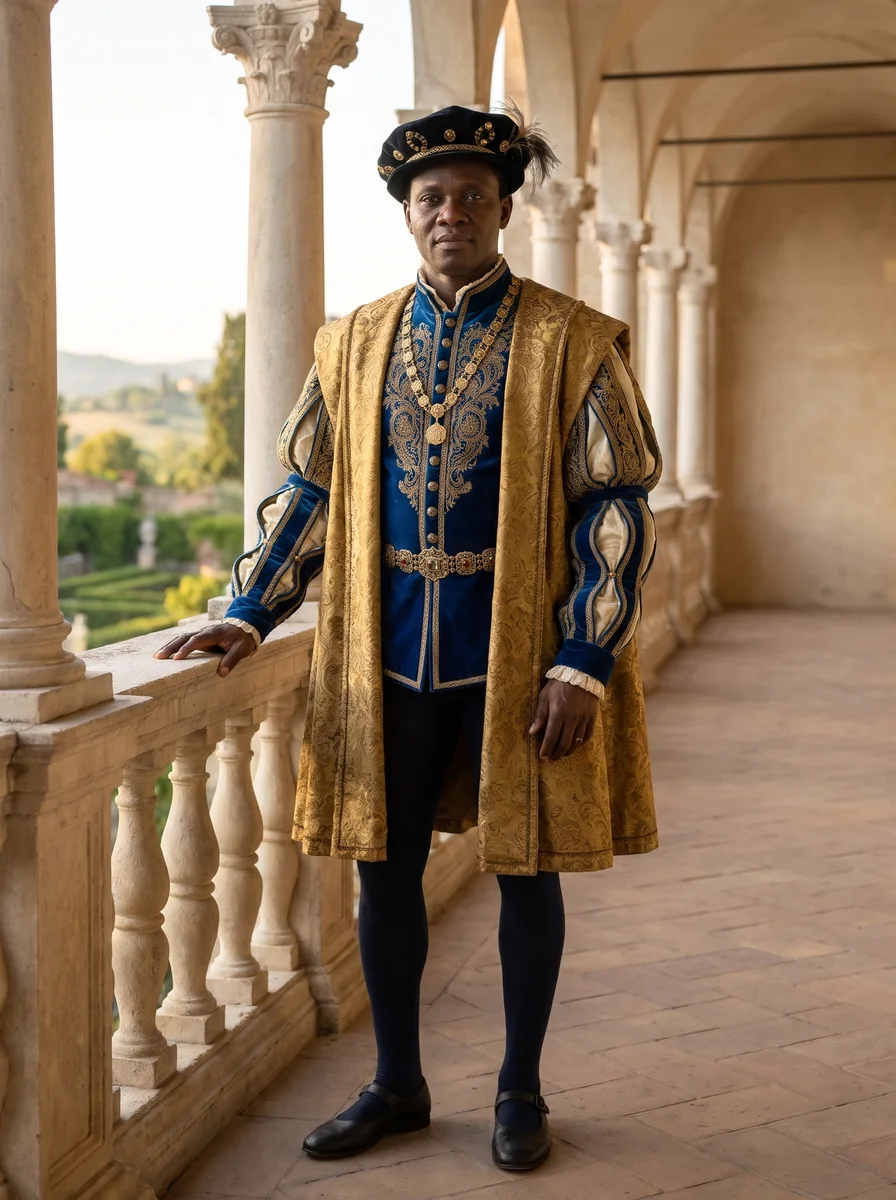
Choose an available outfit first, then use the scene field for pose, background and light. Review the face, hands and garment outline before sharing. The photo-to-portrait guide explains the workflow; see pricing and the photo-processing policy before generating.
Editorial note: this source-based introduction was researched with AI assistance and edited for the stated historical scope. Sources were reviewed on 15 November 2026. The cover is an AI-created editorial illustration, not a verified reconstruction; the product examples are documented AI outputs. HistoryOutfit publishes this guide and sells credits for its portrait service.