FASHION HISTORY · MEDIEVAL LAYERS
Medieval Clothing Layers: Kirtles, Gowns and Houppelandes
Read medieval clothing from the body outward: an undergarment, a fitted dress or body layer, then any outer gown or robe. Kirtle, gown and houppelande describe different things in different sources; they are not a universal three-piece uniform. This guide concentrates on late-medieval Western Europe, especially northern French, Burgundian and Netherlandish examples around 1400–1460.
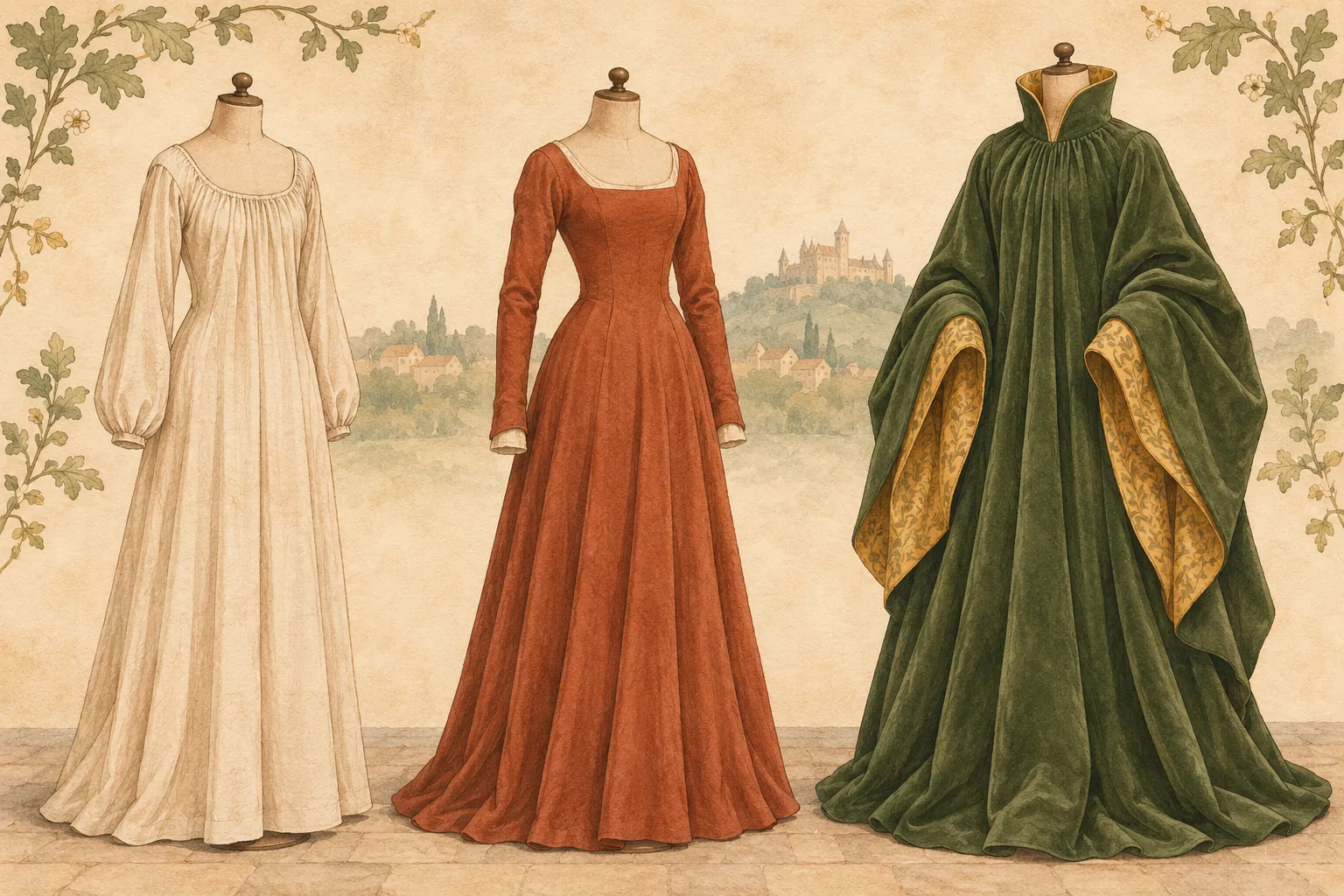
Identify the layer’s job before naming it
The first question is whether you are seeing the garment against the skin, a fitted dress beneath something else, or the outer silhouette. FIT’s account of dress around 1400 gives context for the comparison below. Use the table to read a particular image, rather than treating it as a compulsory outfit for every medieval woman.
| Term or layer | Role in this comparison | What a picture may reveal |
|---|---|---|
| Chemise or smock | Body undergarment. | A small neckline or sleeve edge; often concealed. |
| Kirtle or fitted dress | A fitted garment that may sit under another dress. | Close torso, sleeves or contrasting fabric at an opening. |
| Gown | A broad contextual name, not a fixed pattern. | Describe the actual neckline, sleeves and fullness. |
| Houppelande | A full outer garment associated with particular fashions. | Volume, sleeves and belt placement; length varies. |
A coloured area at a neckline is not automatically another whole dress. Neckline coverings and trim can also interrupt a silhouette. Keep an unidentified detail descriptive until the source gives you enough information to name it.
A kirtle is not a shorthand for every medieval dress
In its early-fifteenth-century discussion, FIT relates the French côte-hardie to the English kirtle and Italian cotta. The garment has a fitted torso and fuller skirt. These names are useful within that discussion, but they should not become an assertion that every language, decade or wardrobe used identical categories. Read the terminology alongside the dated examples.
For a visual comparison, separate cut from position. “Fitted” describes the relation to the body; “under” describes the relation to another garment. An image can show a fitted dress without proving that it was always hidden. Equally, a contrasting sleeve need not tell you the construction of the whole garment to which it belongs. Record what you see before assigning a complete wardrobe to the person.
This matters for a maker’s brief. A painting can give a target outline, while a wearable reconstruction still requires decisions about seams, fastenings and support. Do not derive those hidden decisions from an attractive AI picture. If construction is your goal, keep that question separate from choosing the visual direction of a portrait.
Houppelandes change with date and wearer
The houppelande belongs to outerwear, and it was worn by women and men. FIT’s 1400s overview describes the full silhouette and expansive sleeves of fashionable examples. The name does not identify one neckline or hem length for the entire Middle Ages. Even within a short span, a long ceremonial shape and a shorter outer garment need separate descriptions.
By the 1450s, FIT finds northern European men’s outer garments growing shorter, with full-length houppelandes increasingly formal and the word itself less frequent in documents. Its 1450s account also distinguishes northern and Italian dress. A shape documented in Florence should therefore not silently become the standard outfit of a Burgundian courtier.
Compare shoulder line, sleeve opening, belt and hem together. If your reference dates to around 1400 and your headwear comes from a much later picture, save both dates rather than calling the mixture one documented ensemble. For a fantasy character you may choose that mixture deliberately; for a historical comparison it weakens the claim you can make.
Read two dated paintings from the outside inward
The Arnolfini Portrait, 1434
The National Gallery describes the woman’s green wool overdress, its cut decorative sleeve edges and the train gathered around her feet. Its audio description identifies blue underdress sleeves visible at her forearms. Those details offer a clear outside-to-inside comparison: the dominant green shape is not all the clothing present. Read the painting’s in-depth entry and description.
The same museum explains that the setting and appearance were carefully composed to convey wealth. Treat this as a wealthy merchant portrait associated with Bruges, not a picture of everyone’s everyday dress. The record helps identify visible layers; it does not let you count every hidden garment or recover a complete cutting plan.
Portrait of a Female Donor, about 1455
The National Gallery of Art’s Petrus Christus record describes a red gown with grey fur edging and cuffs, a belt, and translucent cloth across the chest beneath an elaborate headdress. Compare those neckline details with the green overdress and blue sleeves of the earlier portrait. The visible contrasts occur in different places; neither picture reduces to “a dress plus a veil.”
FIT interprets specific neckline pieces in the donor portrait within its discussion of northern European women’s dress. Keeping the museum description beside that interpretation makes the distinction useful: one records what is visible, while the other places it within garment terminology. A small dark or pale insert should not become an invented full undergown in your notes.
What manuscript images can and cannot prove
Getty’s Fashion in the Middle Ages exhibition explains how manuscripts use clothing to communicate status and profession, while also presenting idealized or fanciful dress. Biblical and historical subjects can deliberately evoke other times or places. A book’s production date therefore needs to be considered alongside the identity of the figure and the purpose of the scene.
Before borrowing a detail, note the work’s date, production location, depicted subject and collection identifier. Ask whether you are looking at a donor, an allegorical figure or a character from a distant past. Compare another dated source before treating one unusual sleeve as normal regional practice. Where the evidence stops, leave a gap in the brief instead of filling it with a confident garment name.
Use the layer map in a portrait brief
Choose the reference’s place and date first, then write one sentence about the silhouette and one about the visible layer contrast. Add the setting afterward. This keeps a stone hall from doing all the work of making an otherwise unrelated outfit look medieval.
HistoryOutfit’s medieval clothing collection contains a Burgundian-inspired gown and a houppelande-inspired men’s robe. Its men’s illustration has a near-knee hem. These are artistic selections with a fifteenth-century courtly direction, not a catalogue of every layer discussed here. There is no separate selectable kirtle, chemise or reconstructed garment pattern.
Use the available look to explore a portrait concept, and keep dated sources for questions about construction or historical accuracy. Check the generated face, hands, sleeve openings and garment edges before sharing. Label AI imagery clearly when using it in a research or learning context; a convincing surface is not evidence for a hidden layer.
Compare the available portrait interpretations
These examples are existing HistoryOutfit test outputs made with synthetic adult source portraits. They illustrate the available creative styles; they are separate from the historical sources cited above. Clothing details and facial features can change in an AI result.
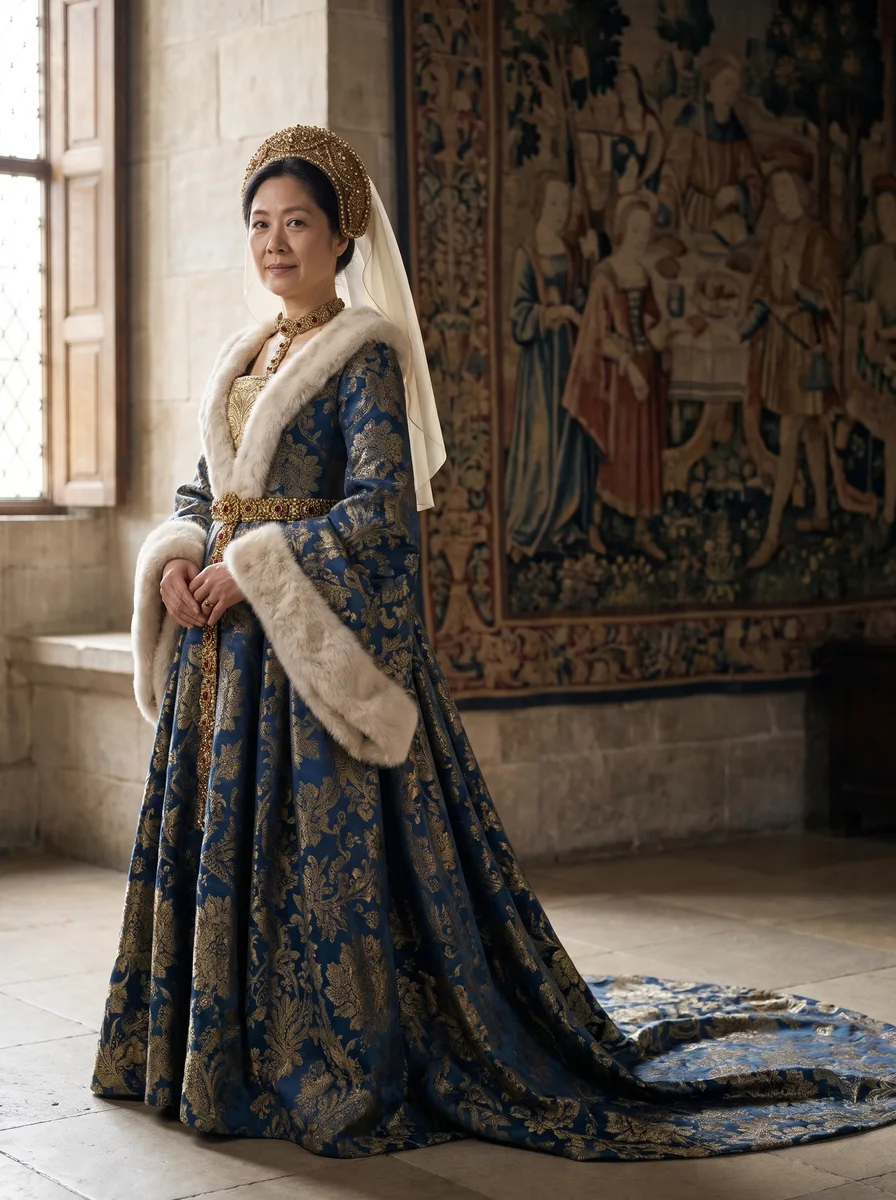
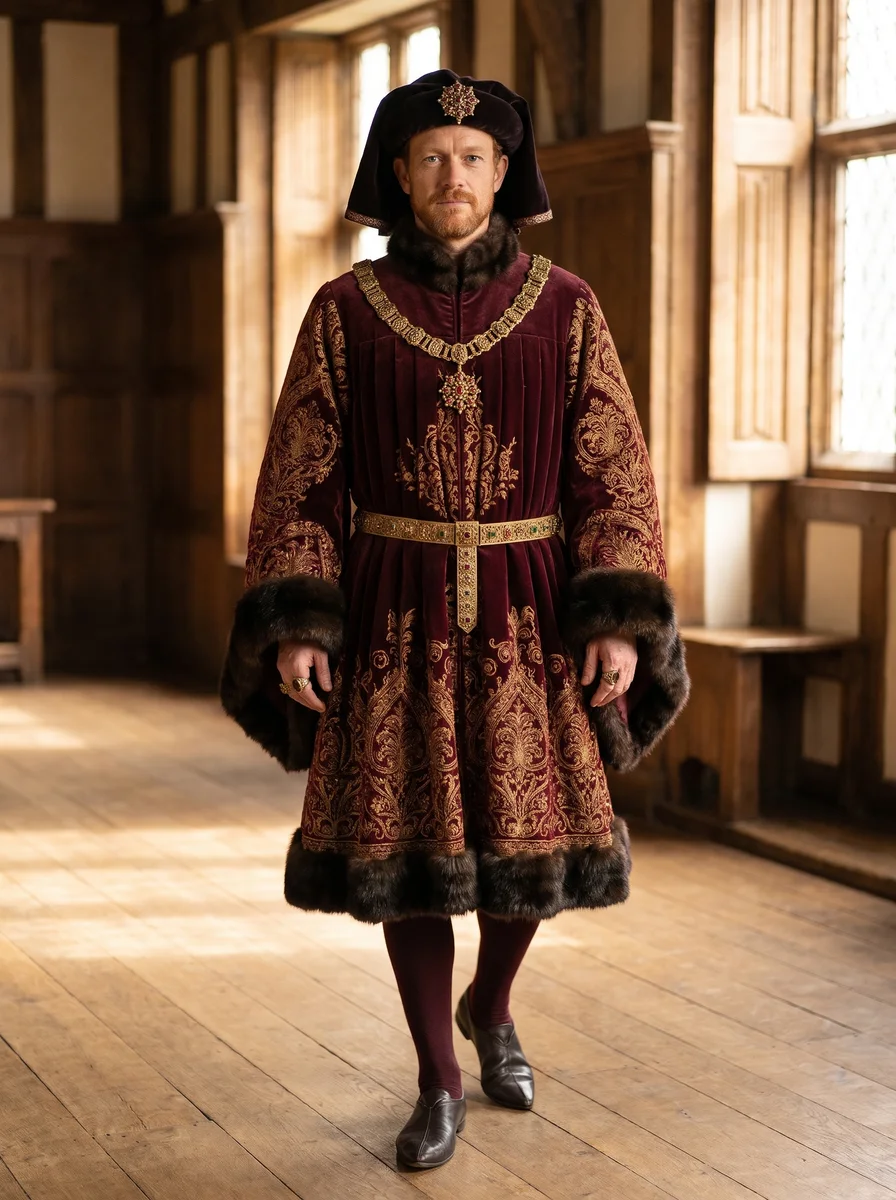
Choose an available outfit first, then use the scene field for pose, background and light. Review the face, hands and garment outline before sharing. The photo-to-portrait guide explains the workflow; see pricing and the photo-processing policy before generating.
Editorial note: this source-based introduction was researched with AI assistance and edited for the stated historical scope. Sources were reviewed on 15 November 2026. The cover is an AI-created editorial illustration, not a verified reconstruction; the product examples are documented AI outputs. HistoryOutfit publishes this guide and sells credits for its portrait service.