FASHION HISTORY · 1920S MENSWEAR
1920s Men's Fashion: Suits, Daywear and Evening Dress
Choose the occasion before the accessories. A daytime suit, golfing outfit, dinner jacket and evening tailcoat answer different briefs. This guide compares 1920s men’s fashion through British and American references, with an Australian museum ensemble for comparison. It helps you read a photograph or plan a portrait without turning the whole decade into one Gatsby party costume.
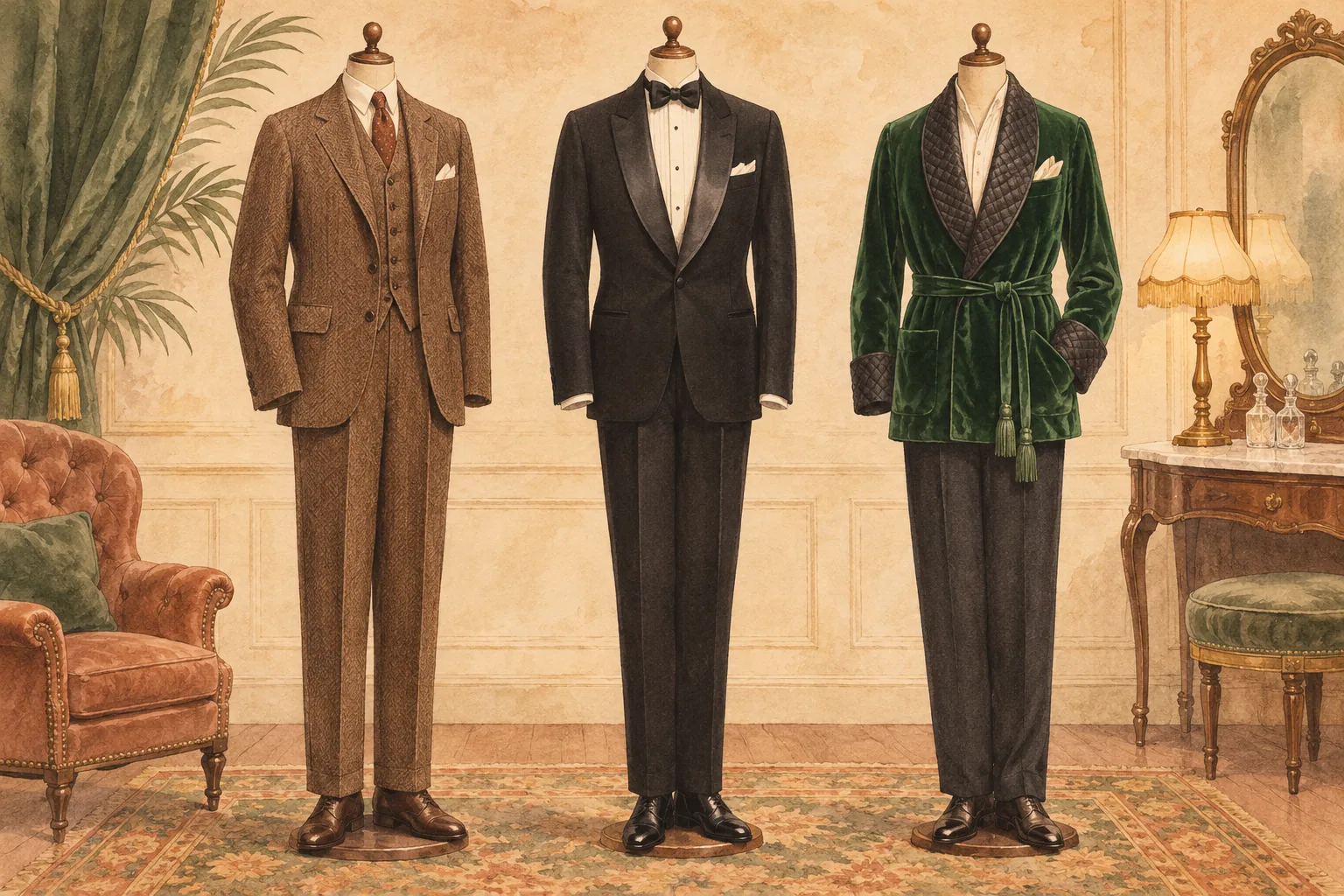
Match the clothes to the occasion
Begin with what the person is doing, then compare the coat and trousers. A bow tie alone cannot tell you whether a look is business, evening or a modern costume. The distinctions below are a reading aid; a present-day invitation still needs its own dress instructions.
| Situation | Category to investigate | Detail worth checking |
|---|---|---|
| Ordinary town or business setting | Day suit, also called a lounge or sack suit. | Coat cut, matching trousers and any waistcoat. |
| Sport or relaxed country setting | Sporting separates, knitwear or plus-fours. | Activity, trouser length and visible stockings. |
| Formal daytime function | Cutaway or morning-coat references. | Long coat fronts and contrasting striped trousers. |
| Dinner or evening entertainment | Dinner suit or tuxedo. | Tailless jacket, lapel facing and black bow tie. |
| Most formal evening setting | Evening tailcoat or full dress. | Rear tails, white waistcoat and white bow tie. |
The formal distinctions follow chapter XXXIV of Emily Post’s 1922 Etiquette; sporting context comes from FIT’s account of the decade. Post describes the expectations of affluent American society. Her instructions are evidence of a particular social code, rather than a report of what every man wore.
Read a day suit as a complete ensemble
A useful starting object is the Met’s American wool suit dated about 1920. Its record establishes a date, a material and a surviving object. It does not tell you that every American man owned an equivalent suit, or that one cut lasted unchanged until 1929. Save that collection record beside a reference image so its approximate date stays attached to it.
FIT describes a move toward softer collars and less formal day suits, sometimes without a waistcoat. Tweed and flannel also appear in its account. That permits several daytime directions; it does not make a three-piece suit wrong. Look at the relationship between shirt, coat, waistcoat and trousers before deciding that one isolated garment is characteristic of the decade. See the menswear section and its dated illustrations.
When comparing two references, keep the framing similar. A seated head-and-shoulders photograph may conceal the waistcoat and almost all of the trousers. A standing view lets you judge the full balance. Note what the image actually shows, and mark the rest as unknown. A dark photograph is especially poor evidence for an exact fabric colour.
Oxford bags and plus-fours belong to different comparisons
Oxford bags are wide, full-length trousers associated with youthful fashion around 1924–25. Plus-fours are a different shape: fuller knickerbockers gathered near the knee, with cloth hanging over the fastening. FIT connects the latter with golf and wider leisure dress. These are alternatives within the period, rather than two names for the same oversized trouser. The university’s decade overview supplies the context and examples.
For a visual brief, decide whether the lower leg should be inside a long trouser or visible in stockings below a gathered knee. That single distinction does more useful work than adding a golf club to a generic suit. It also affects your crop: a close portrait cannot explain a trouser silhouette. Choose a wider composition when the garment’s length is the point of the comparison.
Dinner jackets and tails are separate evening choices
Post distinguishes the tailless dinner coat, worn with black neckwear, from full evening dress with a white tie and waistcoat. In her 1922 account, balls and formal dinners call for tails, while the tuxedo serves less formal evening occasions. Her evening-clothes discussion is useful precisely because it names those different settings. Do not transfer every rule in that chapter to other countries, later years or a modern themed event.
A surviving comparison comes from Sydney: Powerhouse records a Hordern Bros evening suit dated about 1925. The ensemble includes jacket, waistcoat and trousers in black wool, with silk lapels on the jacket and waistcoat. Those named components give you a firmer reference than an image merely tagged “roaring twenties.” The museum’s Australian attribution should travel with the example; it is not evidence that all evening suits everywhere were identical.
NYPL also preserves the catalog record for Fairchild’s 1922 chart of formal evening dress, explicitly framed around well-dressed New York men. Its narrow description is a useful habit to copy: date, location, intended wearer and occasion make a reference more informative. A trade chart presents a standard to readers; it cannot establish how often the public followed it.
Where the green smoking jacket fits
A smoking jacket is not another name for a business suit. The Met holds a silk smoking jacket from the 1860s, attributed broadly to America or Europe. It establishes that the category predates the twenties. It does not authenticate a particular green-and-gold design as an original garment from 1925.
HistoryOutfit’s 1920s clothing collection offers one men’s look: the Peacock-Green Smoking Jacket, with ornamental gold details, bow tie and dark trousers. Choose it for a colourful indoor portrait. The collection also has a beaded dress; it does not currently offer the day suits, sporting outfits or evening tails compared above. A scene description changes the portrait brief, not the list of selectable clothes.
Build a reference brief you can check
Write down a year or short date range, a place and an occasion. Next, describe the coat, trousers and neckwear visible in your chosen source. Keep the museum link with those notes. If your goal is a physical outfit, compare that brief with dated garments and the actual event instructions before buying pieces. A digital image cannot predict tailoring, fabric behaviour or fit.
For the available smoking-jacket portrait, a quiet interior and a three-quarter pose can leave the lapels and ornamental front visible. Review the generated face, hands and clothing details before sharing. Label the picture as an AI interpretation, particularly when placing it beside period sources. The useful result is a clearly described historical inspiration whose limits you can explain.
Compare the available portrait interpretations
These examples are existing HistoryOutfit test outputs made with synthetic adult source portraits. They illustrate the available creative styles; they are separate from the historical sources cited above. Clothing details and facial features can change in an AI result.
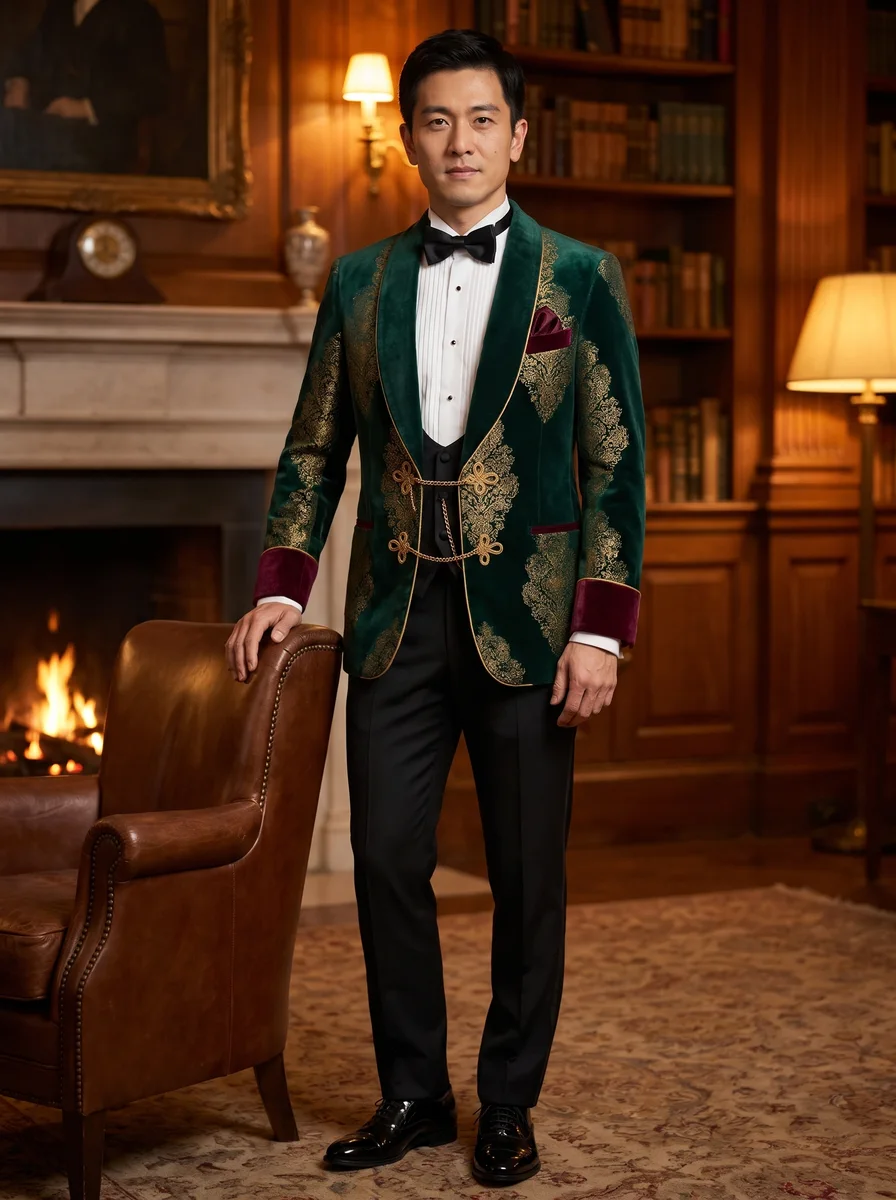
Choose an available outfit first, then use the scene field for pose, background and light. Review the face, hands and garment outline before sharing. The photo-to-portrait guide explains the workflow; see pricing and the photo-processing policy before generating.
Editorial note: this source-based introduction was researched with AI assistance and edited for the stated historical scope. Sources were reviewed on 15 November 2026. The cover is an AI-created editorial illustration, not a verified reconstruction; the product examples are documented AI outputs. HistoryOutfit publishes this guide and sells credits for its portrait service.